Technology in the Service of Patients
IT in a hospital involves collation, segregation, storage and retrieval of data pertaining to all aspects of the hospital. SSSIHMS has one of the best IT implementations in India among hospitals. In addition to the latest in Medical Technology to provide the best medical treatment, SSSIHMS is also technologically advanced to enhance its capabilities to serve patients better. Technology is effectively used to facilitate the operations of the hospital, to improve the utilization of infrastructure in a cost effective manner.
ATHMA — Hospital Operating System
The Institute’s hospital information system is ATHMA, the hospital operating system developed by Narayana Health, which replaced the earlier Dedalus Enterprise Management platform. ATHMA offers a single platform for storing and processing patient records, allowing medical staff and patients to access a comprehensive medical history swiftly and efficiently.
Its scope extends well beyond record-keeping: the suite covers the clinical electronic health record, laboratory information system, ambulatory care, billing, inventory management and pharmacy, together with role-specific applications — Aadi for doctors, Namah for nurses, Aham for administrators and a patient-facing care app. The modules are designed around the everyday work of clinical teams, so they need very little training before use.
ATHMA has been built over two decades of development within Narayana Health and is now deployed across hospital networks in India and abroad. In practice it automates critical hospital functions, reduces paperwork and shortens documentation and reporting times — clinicians spend less time on the record and more with the patient.
MedDream PACS
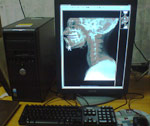
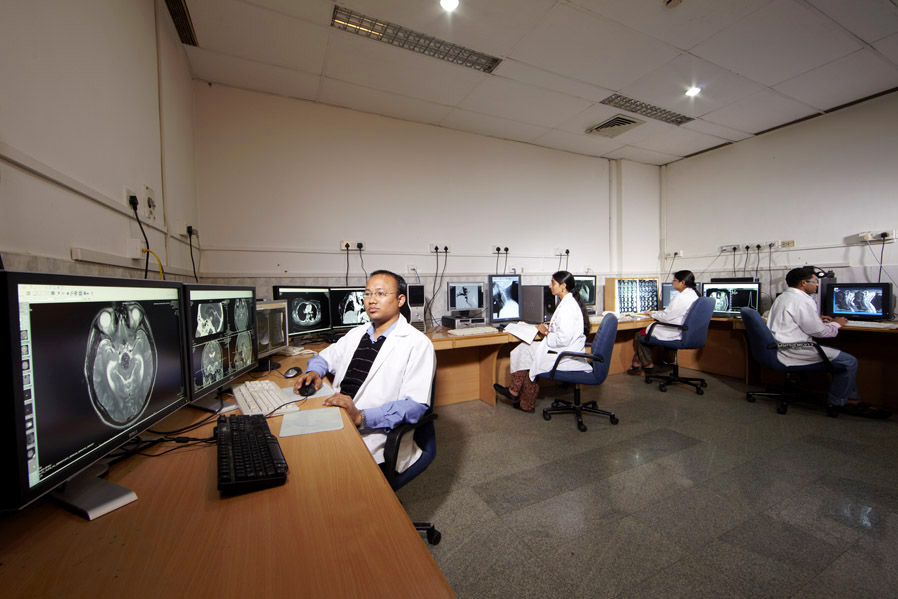
Radiology imaging is now managed on MedDream, which replaced the earlier FUJIFILM SYNAPSE installation. MedDream is a DICOM 3.0 compliant picture archiving and communication system with a web-based, zero-footprint HTML5 viewer — nothing is installed on the reporting workstation, and studies open in an ordinary browser.
The PACS server connects to all DICOM modalities on campus — CR, DX, CT, MR, ultrasound and angiography — and archives, forwards and distributes their images from a single system. Studies can be auto-routed to secondary archives, and an HL7 interface links the archive to the hospital information system so that images and reports travel with the patient record.
The viewer carries a full radiology tool set: zoom, pan, windowing and magnification alongside advanced features such as hanging protocols, cine mode, reference lines, PET-CT fusion, 3D/MPR reconstruction and a wide range of measurements. Because it is responsive, radiologists and clinicians can review studies on desktops, tablets or phones — within the hospital or over a secured connection from outside — and more than one clinician can open the same study at once, which makes remote discussion straightforward. MedDream is FDA cleared and CE Class IIb certified for diagnostic use.
Microsoft Dynamics NAV
The in-house Inventory Management System has been replaced by Microsoft Dynamics NAV, a full-fledged enterprise resource planning platform. NAV brings core functions — finance, purchasing, inventory, warehousing and reporting — onto a single system, so hospital data is centralised rather than spread across separate applications.
On the materials side, the supply chain and inventory modules track every item from the purchase order to the point of consumption: stock levels and unit costs at each store, reorder points, transfers between locations and goods in transit. Quantity and cost records post to the inventory ledger, which supports costing, valuation and cost-effective procurement of medical consumables.
On the finance side, NAV provides the general ledger, accounts payable and receivable, fixed assets and budgeting, with financial reporting drawn from the same records that the stores and purchase departments work in. Sales, purchasing and inventory sit together, so stock availability and commitments are visible in real time, and automated workflows reduce manual entry and reconciliation.
The Department and the Campus